

Writing the book, Recycle Angel, I taught myself about recycling and know it helps to save resources. In the story Freddy runs the recycling business that his granddad set up. Driving an environmentally friendly E-van, with zero emissions, he makes a living collecting recycling and selling it.
Researching recycling I learned about climate change and when the book was published I decided to collect information and write about it in my blog. To read what I found about local training, wind turbines, solar farms, hydrogen driven vehicles, hydrogen production as well as anything else you can look back in my blog. Keeping an eye on local activity I was disappointed to find a few local authorities propose to build a new Waste to Energy (WtE) plant. I describe a WtE plant in the book. It is an incinerator that creates carbon dioxide, a greenhouse gas that contributes to global warming and climate change. I wrote to UK Without Incineration Network (UKWIN)** and received this reply: ‘The good news is that it is not too late for the Councils to call a halt to their procurement of an incinerator!’
I did the boring research and discovered why the councils provide a fortnightly service. Of course they want to give the best service and get the best ‘recycling rate,’ which is the percentage of household waste sent for reuse, recycling or composting. But the service is fortnightly because councils are constrained by a guidance document ‘Waste collection services: guidance for local authorities’, published 23, July, 2021*. It states that dry recyclables are low health risk yet it specifies waste, including recyclables, should be collected at least fortnightly.
While Freddy drives an E-van the Council uses diesel lorries that run on diesel, emit nitrogen oxides (NOx), non-methane hydrocarbons (NMHC), carbon dioxide (CO2) and put Particulate Matter (PM) in the air. They contribute to climate change and harm the environment. I looked for a solution, something that will stop the emissions or at best reduce them.
Electric or hydrogen powered bin lorries did not present themselves, nor did a tram-like service with overhead power lines. The best alternative appeared to be reduce collection frequency.
Current legislation requires councils to collect recycling at least fortnightly. Changing the legislation so that collections can be made every four weeks would halve the problem.
Customers pay handsomely through council tax to have their recycling collected. Councils are required do collections at least every two weeks, to save resources. If customers knew how damaging those collections are would they choose to save resources or the Planet? I say tell them that reducing collections will benefit everyone. Councils will use less diesel. It will cost less, reduce effects on solar warming and climate change, be better for the environment and good for everyone.
Changing recycling collections to up to six weeks would look like this!
It can take six weeks to fill my recycling bin! Mine and many other people’s does not need to be emptied every two weeks. I would like to see the legislation changed!
FROM EMPTY TO FULL IN 6 WEEKS
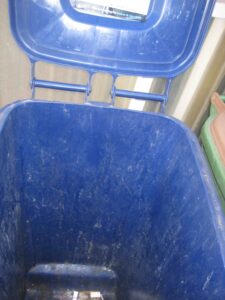

A small non-scientific survey among friends and acquaintances showed different attitudes to recycling. Some are committed to putting out their almost empty bin every two weeks, on the day set by the council, and others wait until the bin is nearly full before putting it out. Most people have a paper caddy in their bin. Paper is recycling and does not have to be separated from the other recycling! The Redcar and Cleveland Operations Manager for waste and recycling… and Guisborough Town Mayor both assured me I don’t need one so I don’t have one. Without it there is 240 litres of empty space and as you can see I filled my bin to the top. It took six weeks!
I have petitioned a few local authorities and others to ask their views about changing the guidance from two weeks to six and waiting for a response. Below is a redacted email I sent to one. I have asked them to write to the local MP to get new legislation.
I would be pleased if all readers contacted their MP to support the request for new legislation to make the change. Ask government to change the requirement in ‘Waste collection services: guidance for local authorities’ from fortnightly to up to six weeks so that councils can do the logistics, change collection periods to get the best improvement they can.
Dear …
I understand you will attend the … to speak about your work and the Council’s climate action plans. Would you please comment on a suggestion I have for (your) County Council and other local authorities to cut spending on diesel and reduce carbon emissions.
I am aware that recycling saves resources and it is very important to dedicate time to educate customers to give them confidence in the process.
In accordance with the document, Waste collection services: guidance for local authorities* published 23, July, 2021, which states that dry recyclables are low health risk yet it specifies waste, including recyclables, should be collected at least fortnightly councils collect household recycling at least every two weeks. Changing collections from fortnightly to every four weeks, for example, would potentially halve diesel usage, costs and related carbon dioxide emissions. Greater savings would be possible if the period between collections is increased further. The savings would be measurable.
I know … County Council has identified that transport accounts for 34% of UK emissions and have plans to reduce car travel and thinking about electric bin lorries when the current fleet needs replacing. You have the ambition to do everything you can to reduce the council’s carbon footprint. In your vision and ambitions you recognise that to achieve your aims you will need government support and legislation. Legislation to change household collections from fortnightly to up to six weeks will need government support!
I realise new legislation is needed quickly and a request to create it needs support so I have done a small non-scientific survey. I asked friends and acquaintances how long it takes them to fill their recycling bin? A number of them do not fill theirs in two weeks so only put them out for collection when it is necessary. A number are committed to putting out their almost empty bin every two weeks on the day set by the council. The answers to my question depended on various factors and ranged from two weeks to five. However, it is significant that many of those I consulted have a paper caddy. I estimate a caddy takes up almost a third of the space in the bin. The Redcar and Cleveland Operations Manager for waste and recycling… and Guisborough Town Mayor assured me I don’t need one so I don’t have one. Without it there is 240 litres of empty space and with good management, compacting recyclables, it can take up to six weeks to fill my bin. Mine does not have to be emptied every two weeks!
I believe that with all paper caddies removed from recycling bins and legislation in place to change collections from fortnightly to six weeks authorities will be best placed to reduce diesel usage, lower spending and reduce CO2 emissions.
If you choose the Planet please support the request for new legislation to change household recycling collections from fortnightly to six weeks please will you write to your MP. The sooner the legislation is in place the sooner savings can be made. THANK YOU.
**Ref: https://ukwin.org.uk 08.06.2022
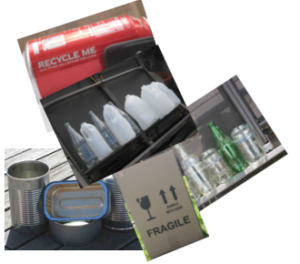

MIXED DRY RECYCLABLES:
ALUMINIUM AND TIN CANS, GLASS BOTTLES AND JARS, PLASTIC BOTTLES AND CARDBOARD (more…)
Oil fuels war. We’re taking action.
Greenpeace activists have stopped a tanker carrying £30m of Russian diesel from docking in the UK.
Activists stop Russian tanker carrying an estimated £30million of fossil fuels
Oil and gas fuels war. And the war in Ukraine is no exception. The government promised to block Russian-owned ships coming into the UK, but Putin’s oil and gas is still getting through. So we showed them how it’s done.

Greenpeace aim to show the government it’s time to commit: reduce single plastic use by 50% by 2025. Everyone, including schools, can join in so if you don’t mind counting your plastic waste for a week and want to be part of it check out the website. I have signed up at thebigplasticcount.com

BBC Newsround explains simply that petrol and diesel are fossil fuels. When used they give off carbon dioxide (CO2). It is a greenhouse gas which is harmful to the environment. It causes global warming. In the government’s 10-point plan to tackle climate change the sale of new petrol and diesel cars will be banned after 2030.
When you’re heading for a crash you instinctively put your foot on the brake. You don’t expect to have to wait 10 years to stop!
Local authorities vehicles, which do not appear to be included in the 10-year plan, use fossil fuels. Authorities can prioritise the waste collection services if there is unexpected pressure on resources.
I don’t know if they consider fuel one of those resources. If they do I hope they will look at ways to reduce usage because it has an adverse effect on the environment, climate change and authority spending.
In the publication, ‘Waste collection services: guidance for local authorities’, recycling is considered low health risk and collections may be weekly or fortnightly.
To reduce fuel consumption I suggest ALL local authorities should commence fortnightly collections as soon as possible and the government should begin research immediately to establish the interval between collections can be extended. Researchers may discover it is possible to extend the period to 3 weeks or more.
The publication states that if local authorities consider changing to fortnightly collections they must consider collecting recycling materials waste paper, metal, plastic and glass by separate collection.
A change like that might have a significant, favourable effect on recycling. Customers find it easier, the reprocessor may find quality improves and over-all the results could be positive. I have seen the 2018/2019 record of recycling rates of 345 local authorities. They range from 14.1% to 64.8%. I would hope that rates could be improved, more material baled and fit for recycling.
The publication states that if local authorities consider changing to fortnightly collections they must consider collecting recycling materials waste paper, metal, plastic and glass by separate collection.
Careful collection of those materials could ensure more recycling presented to reprocessors will be of better quality. A higher percentage of material will be fit for baling and reuse.
The publication shows that if changes are to be made contracts between authorities and reprocessors will need to be reviewed.
Conclusion
Those who are concerned for the environment, climate change and authority spending should find the suggestions in this document interesting. If these suggestions become recommendations and are acted on by government and local authorities the impact on the environment, climate change and spending will be significant.
Although the three objectives set out do not directly affect Ukraine, reductions in fuel consumption may help. Also, more thought could be given to green projects and training.
References 16.05.2022
Reference: https://www.bbc.co.uk/newsround/54985070
Reference: https://www.letsrecycle.com
Reference: https://thebigplasticcount.com
Reference: https://www.greenpeace.org.uk/news/russian-diesel-tanker-action/
When quoting this please refer to: https://www.recycleangel.co.uk THANK YOU.
IS THERE A BETTER WAY?
The Council has adopted the single-stream system but I argue in favour of the multi-stream system in my book and here too.
This morning I was reminded that some time ago my local Authority supplied every home with bags and boxes in a Council multi-streaming recycling project. Like most Council’s it eventually decided householders could not separate their waste. It decided to change to a single-stream system. It replaced the bag and box with a big blue recycling bin and told customers to put all recycling in it. Helpfully, a list of materials that can be put in recycling was provided. Mine is still inside my bin. It is stuck to the lid.
Putting recycling into one receptacle is easier for customers and emptying one is easier for Council loaders and drivers. In many ways the single-stream system is ideal, but the recycling rates are not good!
In 2019, the year I became a member of Guisborough Town Council, RECOUP produced a survey showing challenges Councils find associated with household recycling. The biggest single challenge given was contamination. Other challenges included collection logistics and reduced collection frequency.
MY PERSONAL ASSESSMENTS:
Contamination is often caused by over zealous, ‘wish recycling’ customers. When they are not sure which bin to use they sometimes get it wrong. There is nothing to guide a correct decision.
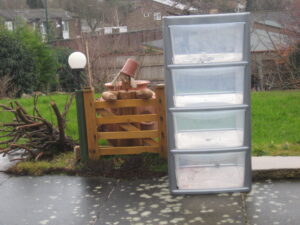
I have trialled collecting recycling in a draw cabinet. It is easy to see which draw an item should go in. If the material does not go in a draw it goes in the general waste bin.
Other problems, such as logistics and collection frequency need to be defined and resolved by the Council.
ARE CUSTOMERS INTERESTED IN RECYCLING?
I advertised Global Recycling Day on social media for a month and got not responses at all. My conclusion is that those customers who use social media were not interested in recycling. Social media is not a good platform for advertising recycling. Councils who rely on that media probably get as much response as me. I know people who observe the labels on packaging, clean it, put it in the recycling bin and forget about it. To them it has no value. I suggest future advertising should be through other media. To be successful it must be given value. Let customers know that money raised through sales of recycling goes into that or other services and helps to reduce council tax.
IS RECYCLING FINANCIALLY AND ECOLOGICALLY VIABLE?
I suggest advertising should aim to assure customers that recycling is beneficial. It is good for the environment, helps reduce climate change and the council tax. Money from recycling goes into services.
HOW MUCH PLASTIC RECYCLING ARE WE COLLECTING ANNUALLY?
I collected my own household plastic from 24th, February to 24th, March 2022 and estimated my annual plastic collection rate.
The charity, RECOUP, does a UK Household Plastics Collection Surveys each year. I have copied mine, and its figures for 2019 and 2021 into the table below.
| RECOUP survey results for Plastic per household per year in 2019 and 2021. I averaged my own results for plastic collected from 24.02.22 to 24.03.22. | |||
| RECOUP
2019 (kg) |
RECOUP
2021 (approx kg) |
My Collection
2022 (kg) |
|
| Plastic bottles + Pots, tubs, trays | 12.65 + 6.91 | 14 + 6 | 12.9 |
| Plastic film | 0.86 | 1 | 2.6 |
| TOTAL PER YEAR | 20.42 | 21 | 15.50 |
My total is less than RECOUP’s, however both are small compared to the effort that goes into collecting and sorting. If I am right, valued at up to £400 per tonne my collection will be worth about £6 per year.
Other recycling materials are collected. They all save resources. Bear in mind that less than 50% of recycling collected is recyclable. Should the cost to the environment and the effect on climate change of fossil fuel driven recycling wagons be accounted for? Recycle Angel shows there is another way!
I am grateful toRECOUP for allowing me to include the figures in this blog.
REFERENCES
recoup-uk-household-plastics-collection-survey-2019-1591878883.pdf Item, Performance Rate – Average Collection Rates per Household per Year, 2019
recoup-uk-household-plastics-collection-survey-2021-1637743422.pdf. Item,
Household Collection Performance. Household Collection Rates, 2021
Fred Page © 2022
THANK THE RECYCLING TEAM
Our Council Recycling Team men and women drivers and loaders have had a tough time during the Covid pandemic. They deserve recognition. Would you like to thank them? Let me know and I’ll pass it on.
This month the local authority has advertised 3 of its priorities include
A carbon neutral borough by 2030
Supporting nature and biodiversity
Improving recycling rates
WE CAN HELP?
In discussion with the refuse and recycling management I found they need our help. You know recycling saves money, resources, helps the environment and helps reduce climate change. The question is – can we take the time to help? Here are a few reasons why we should:
MONEY
Darlington Borough Council advertises the more we recycle, the better it is for the environment and as an added bonus, we are also paid for every tonne of recycling we collect – money which can be reinvested back into the council and spent on a range of services.
RESOURCES
Friends of the Earth advise that recycling paper, wood, plastic, metal and glass saves trees, fossil fuel hydrocarbons, metal, sand and it saves eco systems and wild life.
CLIMATE CHANGE
Carbon emissions are released when fossil fuels are burned to generate heat and electricity needed in manufacturing products. It is stated that those emissions affect climate change. It is known that less energy is used in manufacturing processes that use recycling. Those processes produces less carbon emissions and that helps reduce climate change.
This might surprise you:
I’m not joking, since last Thursday, Feb 24th, I’ve been multi-streaming my recycling into my draw cabinet, pictured below. It is compulsive recycling. I have 6 soft drinks cans in one draw, 1 jar in another, 7 tins in another and 3 plastic milk bottles in the last one.. All 13 items have value. Making them into something new saves resources, energy and helps reduce climate change. Recycling properly is good for the environment.
Multi-Stream Recycling Draw Cabinet

Recycle Angel
This month Recycle Angel is reported in Saltburn’s own advertiser, Talk of The Town. Everyone recycles stuff but sometimes get it wrong. Read the book to see how Granddad and Freddy sorted out what can be recycled and what can’t.
Thought for the week:
Recycling has grown in popularity recently. Some shops are collecting anything from soft plastic to used clothes and some are giving rewards. In the end we are all rewarded if recycling is not burned and does not add to greenhouse gasses (GHG). I will list some of those shops, later.
We know recycling is sent to Material Recovery Facilities (MRFs) to be separated into metal, plastic, paper etc. I received a well written document last week that detailed the local Council used to send its recycling to a MRF 300 miles away, but recently has it separated locally.
Unfortunately I could not substantiate the claims.
We are all aware of the effects of carbon emissions on the environment and transporting recycling 300 miles would add considerably to the Council’s carbon footprint. It does not sound reasonable.
I feel someone should ask questions:
What are the Council’s carbon emissions?
Where can it make changes to reduce them?
When will it make those changes?
In my book, Recycle Angel, Freddy practiced separating recycling into red, white and blue bins and finds a job collecting, sorting and baling recycling on his doorstep.
This week I will separate mine into draws in my second hand draw cabinet and hope to find it as compulsive as Freddy did.
Wish me luck!
© Copyright 2026 | Designed by Webahead Internet LTD | View our Privacy Policy